Mastering Low Level Design: Design Patterns, UML Relationships, Aggregation, and Composition
Rahul Kumar
5 min read
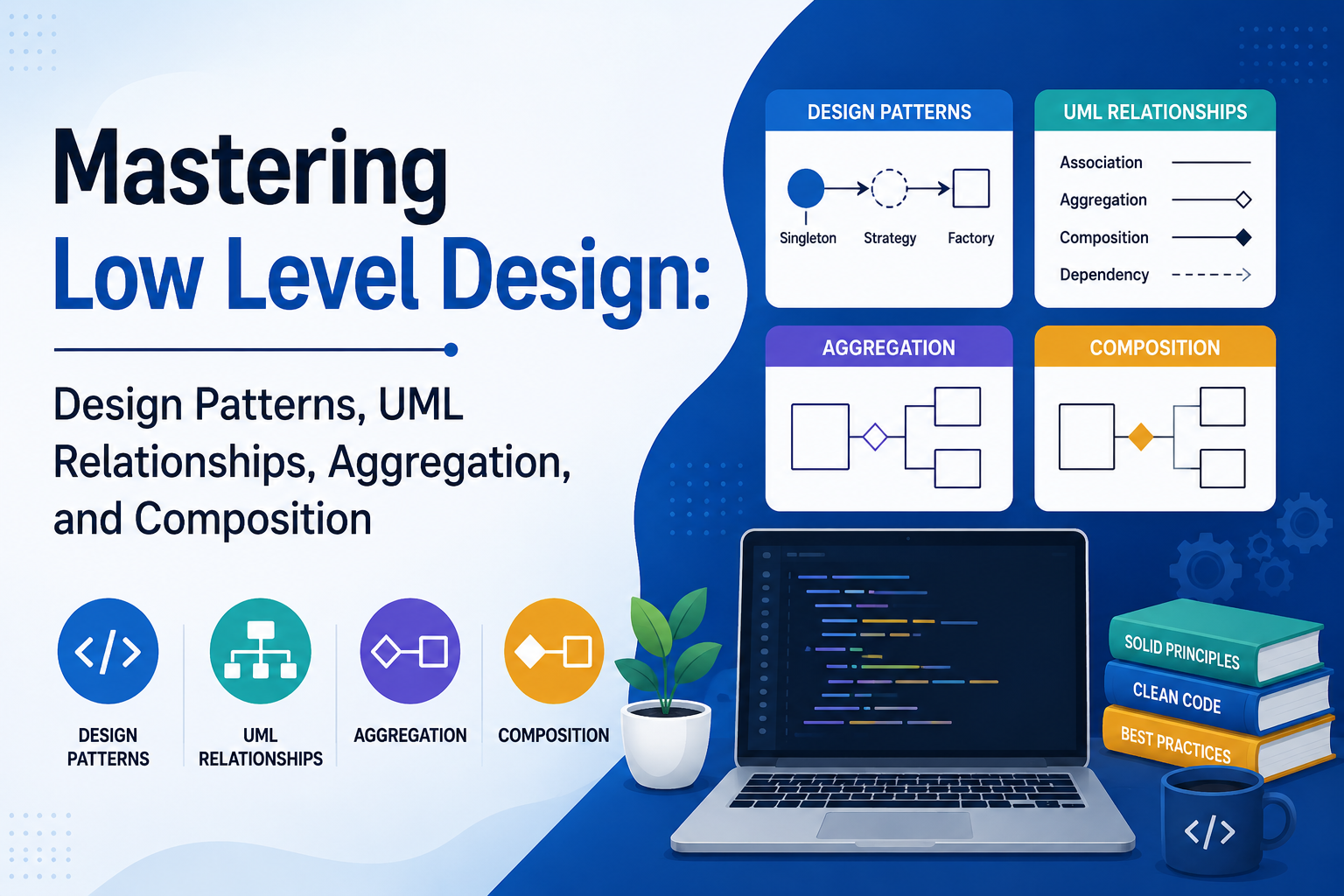
Low Level Design is one of the most misunderstood concepts in software engineering.
Many developers think Low Level Design means drawing UML diagrams or memorizing design patterns. Some believe it is only useful for interviews. Others think it is relevant only for senior engineers.
In reality, Low Level Design is the foundation of writing scalable software.
Every clean backend architecture, every maintainable application, and every extensible system starts with good Low Level Design thinking.
If you struggle with questions like:
- How should I structure my classes?
- When should inheritance be used?
- How do objects communicate properly?
- What is the difference between aggregation and composition?
- Why do design patterns even exist?
Then this guide will help you build strong conceptual clarity.
This is not just another theoretical article.
This guide focuses on practical understanding, interview thinking, and real software engineering decisions.
What Exactly is Low Level Design?
Low Level Design focuses on the internal structure of a software component.
It defines:
- Classes
- Objects
- Methods
- Relationships
- Responsibilities
- Interactions
To understand it properly, let us compare it with High Level Design.
High Level Design vs Low Level Design
Suppose you are building a food delivery platform like Swiggy or Zomato.
At High Level Design level, you discuss services such as:
- User Service
- Restaurant Service
- Payment Service
- Delivery Service
- Notification Service
You discuss:
- APIs
- Databases
- Load balancing
- Caching
- Service communication
That is system architecture.
But now suppose you zoom into the Payment Service.
Now questions become different:
- Which classes are needed?
- Should PaymentProcessor be abstract?
- How should payment methods be added?
- How will retry logic work?
- Which object owns transaction history?
- How should payment validation happen?
That is Low Level Design.
Low Level Design lives between architecture and actual implementation.
Why Low Level Design Matters More Than Ever
Earlier, coding itself was considered a difficult skill.
Today, AI tools can generate syntax very quickly.
But AI cannot always create maintainable architecture with correct object relationships and scalable abstractions.
That is why design thinking has become more valuable.
Good Low Level Design provides several advantages.
1. Maintainability
Software changes constantly.
Business requirements evolve every month.
If your codebase is tightly coupled, even small changes become dangerous.
Good design ensures:
- Easy feature additions
- Minimal side effects
- Cleaner debugging
2. Scalability
Badly designed systems collapse as complexity grows.
Suppose your payment system initially supports:
- Credit Card
- UPI
Tomorrow you need:
- Crypto
- Wallets
- Buy Now Pay Later
If the design is poor, adding new methods becomes painful.
Good design anticipates extension.
3. Testability
Well designed systems are easier to unit test.
Example:
code
class PaymentService {
    private PaymentGateway gateway;
}
Here dependencies can be mocked easily.
Testing becomes simpler.
4. Team Collaboration
In large companies like Google or Amazon, multiple teams work on the same codebase.
Good design helps developers understand systems faster.
Understanding Design Patterns Properly
One common misconception is that developers must memorize every design pattern.
That is not true.
Design patterns are simply reusable solutions to common software problems.
Think about it like this.
Suppose thousands of engineers repeatedly encountered the same problem over decades.
Eventually, proven solutions emerged.
Those solutions became design patterns.
Patterns save developers from reinventing the wheel.
Three Major Categories of Design Patterns
Design patterns are generally divided into:
| Category | Main Focus |
|---|---|
| Creational | Object creation |
| Structural | Object arrangement |
| Behavioral | Object communication |
Let us understand these deeply.
Creational Design Patterns
Creational patterns solve object creation problems.
Object creation may sound simple initially, but large systems often require:
- Controlled instantiation
- Reusable creation logic
- Flexible configuration
- Performance optimization
Singleton Pattern
Singleton ensures only one object instance exists.
Example:
code
class Logger {
    private static Logger instance;

    private Logger() {}

    public static Logger getInstance() {
        if(instance == null) {
            instance = new Logger();
        }
        return instance;
    }
}
This pattern is useful for:
- Logging systems
- Cache managers
- Configuration managers
Without Singleton, multiple instances could create inconsistent state.
Builder Pattern
Some objects become too complex to initialize directly.
Example:
code
User user = new UserBuilder()
    .setName("Rahul")
    .setEmail("rahul@gmail.com")
    .setPhone("9999999999")
    .build();
Builder Pattern improves:
- Readability
- Flexibility
- Immutability
Factory Pattern
Factory Pattern centralizes object creation.
Example:
code
PaymentGateway gateway =
    PaymentFactory.getGateway("UPI");
Instead of creating objects manually everywhere, creation logic stays centralized.
This improves maintainability.
Structural Design Patterns
Structural patterns define how classes and objects combine together.
Think of structural patterns as the skeleton of the system.
Suppose you are building a car.
A car consists of:
- Engine
- Wheels
- Dashboard
- Steering
- Lights
Individually these are separate objects.
Together they solve a bigger business problem.
Structural patterns organize this structure efficiently.
Adapter Pattern
Adapter helps incompatible systems communicate.
Real world example:
Different mobile chargers.
The adapter converts one interface into another.
Software example:
OldPaymentAPI → Adapter → NewSystem
Decorator Pattern
Decorator dynamically adds functionality.
Example:
code
Coffee
Coffee + Milk
Coffee + Milk + Sugar
Instead of creating multiple subclasses, behavior is added dynamically.
Facade Pattern
Facade simplifies complex systems.
Example:
Instead of exposing 20 internal APIs, provide one simplified interface.
Very useful in backend orchestration systems.
Behavioral Design Patterns
Behavioral patterns focus on communication between objects.
Structural patterns create the body.
Behavioral patterns define movement and coordination.
Observer Pattern
Observer enables event driven communication.
Example:
YouTube Channel → Subscribers
When creator uploads video:
- All subscribers get notified
Common usage:
- Notification systems
- Event systems
- Messaging platforms
Strategy Pattern
Strategy allows switching algorithms dynamically.
Example:
code
Payment via:
- UPI
- Card
- Wallet
Each payment type becomes a separate strategy.
This avoids massive if else blocks.
Mediator Pattern
Mediator introduces an orchestrator between objects.
Instead of direct communication:
A → B → C
Mediator handles coordination.
This reduces coupling.
Understanding UML Relationships Deeply
Most beginners struggle with relationships.
This section is extremely important.
Is A Relationship
Is A represents inheritance.
Example:
code
Vehicle
 ├── Bike
 └── Car
Bike is a Vehicle.
Car is a Vehicle.
Inheritance helps in code reuse and abstraction.
Example:
code
class Vehicle {
    void start() {}
}

class Car extends Vehicle {}
But inheritance should be used carefully.
Overusing inheritance creates rigid systems.
Has A Relationship
Has A represents association between objects.
Example:
code
Library has Books
School has Students
Company has Employees
Objects are linked together.
This relationship is usually preferred over inheritance because it creates flexible systems.
Association, Aggregation, and Composition
This is where many interview candidates get confused.
Let us simplify it completely.
Association
Association simply means two objects are connected.
Example:
Teacher teaches Students
Both exist independently.
Aggregation
Aggregation is a weak Has A relationship.
Example:
Library has Books
If library closes, books still exist.
Meaning:
- Lifecycle is independent
- Objects are loosely connected
Example:
code
class Library {
    List<Book> books;
}
Library references books but does not fully own them.
Composition
Composition is a strong Has A relationship.
Example:
House has Rooms
If house is destroyed, rooms cannot exist independently.
Meaning:
- Parent owns child completely
- Lifecycle dependency exists
Example:
code
class House {
    private List<Room> rooms =
        new ArrayList<>();
}
House manages rooms directly.
Aggregation vs Composition Comparison
| Feature | Aggregation | Composition |
|---|---|---|
| Relationship Strength | Weak | Strong |
| Lifecycle Dependency | No | Yes |
| Ownership | Partial | Full |
| Example | Library and Books | House and Rooms |
Practical LLD Interview Advice
Many engineers focus too much on theory.
Interviews require balance.
During machine coding rounds, interviewers usually expect:
- Correct class design
- Proper abstractions
- Working implementation
- Extensible architecture
You should not spend 30 minutes drawing perfect UML diagrams.
Instead:
- Quickly identify entities
- Define relationships
- Clarify responsibilities
- Start coding early
Strong design plus working code creates the best impression.
Best Way to Learn Low Level Design
The best learning approach is solving real design problems.
Practice systems like:
- Parking Lot System
- Elevator System
- Splitwise
- Cab Booking
- Food Delivery
- ATM Machine
- Chess Game
While solving:
- Identify classes
- Define ownership
- Reduce coupling
- Apply patterns naturally
Over time, patterns become intuitive.
Final Thoughts
Low Level Design is not about memorizing UML syntax or blindly applying patterns.
It is about thinking like a software architect.
Great engineers design systems that are:
- Easy to extend
- Easy to test
- Easy to understand
- Easy to maintain
Once you start focusing on object responsibilities and relationships, your coding quality improves dramatically.
That is the real power of Low Level Design.
Related Articles
Retrievers in RAG Explained: Types, Working, and Examples with LangChain
Retrievers are the backbone of every RAG system. This guide covers what they are, how they work, and which types to use, with practical LangChain examples for building smarter AI search and chatbot applications.
Sameer Singh
Vector Stores in RAG Explained: Why They Matter and How to Use Them with LangChain
Discover how vector stores power modern AI search and RAG systems. Learn about embeddings, semantic similarity, indexing techniques, and how to use Chroma with LangChain to build intelligent applications.
Discussion
Sign in to join the discussion.